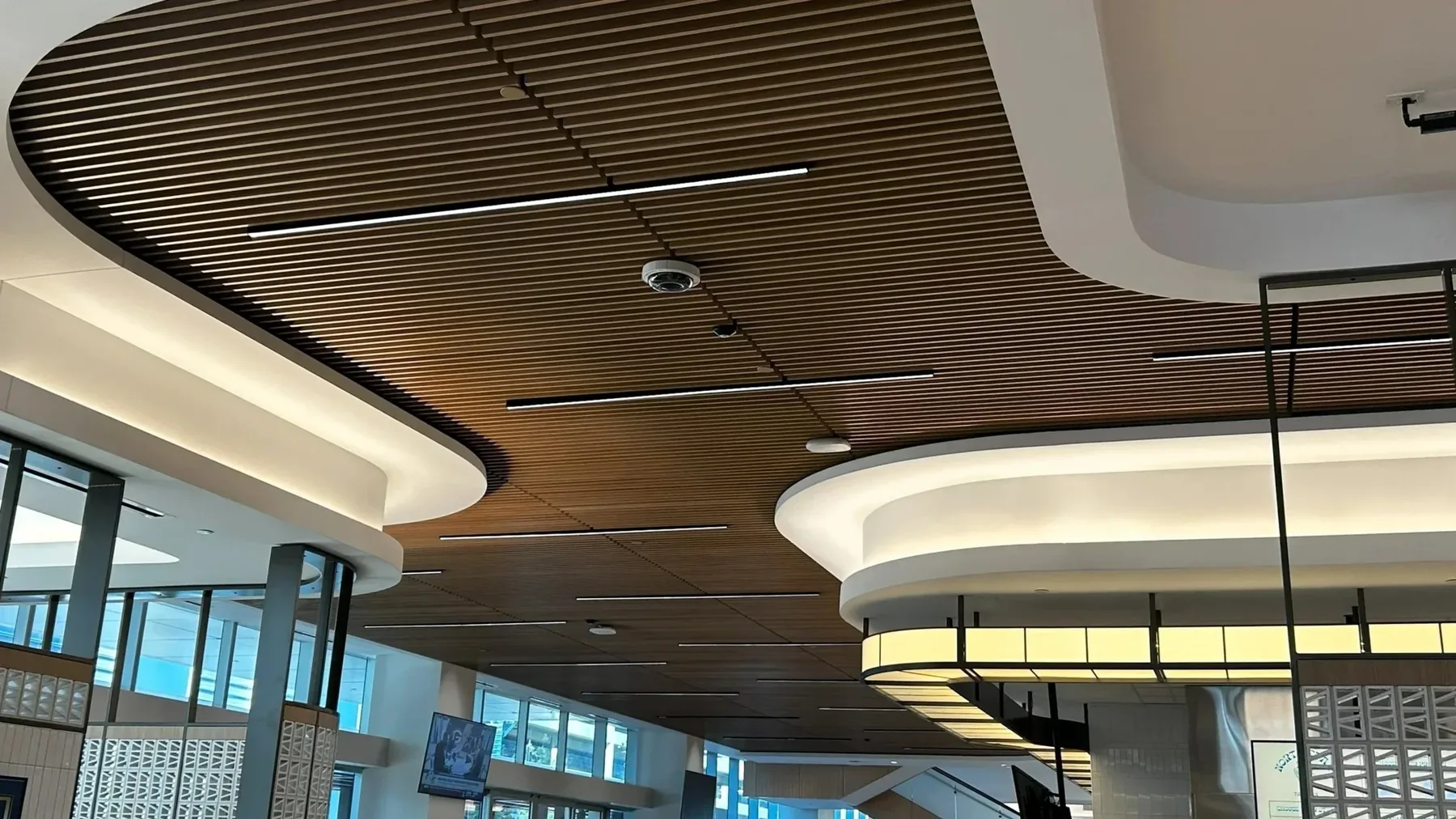
The ceiling is already full.
Slats, linear light, cameras, sensors, sprinklers, diffusers. PAT wins here because it stops firing energy at all of that — and because the column can go where the reflected ceiling plan already left a gap.
The things that aren't in the brochure, aren't in the training deck, and only show up when you've had the gear in your hands or a dealer on the phone at four on a Friday. Nine notes. Read the impedance one first — it's the one that changes a bill of materials.
Vyper and several other passive K-array elements let you select impedance — 16Ω or 64Ω. At 64Ω you can hang sixteen of them on a single 4Ω amplifier channel. That is a full distributed zone on one channel with no transformer anywhere in the signal path.
Every 70V system you have ever commissioned has a transformer on each tap, and each one of those is insertion loss, low-frequency rolloff and a little bit of distortion you learned to stop hearing. The 64Ω approach skips the whole category. You get low-impedance sound quality across a distributed layout — which is the thing 70V was invented to make impossible.
The catch is honest: you are trading the 70V system's easy per-tap level setting for amplifier channels and DSP zones. Budget the Kommander accordingly.
K-array was the first manufacturer to implement Audinate's Dante Ready licensing. The hardware ships with Dante capability dormant. When the job needs it, you connect the unit to the internet and run Dante Activator inside Dante Controller, and you buy only the channel count that job actually requires.
Why this matters on a bid: you stop pricing Dante speculatively. The consultant says 'Dante-capable' and you can say yes without adding a line item that might get value-engineered out — and without shipping a network card to a job that ended up analog.
I am Dante certified and I still think this is the most under-explained thing in the catalog. It changes when you commit money, and that is a cash-flow feature disguised as a firmware feature.
Pure Array Technology means closely-spaced, identical, full-range drivers and nothing else. No tweeter. No crossover. No bass reflex port. No passive radiator. No horn, no waveguide.
Everything that follows comes from that subtraction. With no crossover there is no crossover point to be phase-incoherent at — so phase response holds in the near field and the far field. Because the sources are identical and coupled, the column behaves as a true line source: very wide horizontally, very narrow vertically.
That narrow vertical is the actual product. It means the energy goes at the people instead of at the ceiling and the floor. In a hard, reverberant room the thing destroying your intelligibility is the ceiling bounce, and PAT simply doesn't send much energy there. Front row and back row hear the same tonal balance without a delay ring.
And with no horn to fight, you can join columns end to end to build a longer array.
On EBS products — Kayman KY102-EBS, Mugello, Firenze — directivity is set electronically. You can hang the array dead straight with no inclination angles at all, or in a stepped configuration, and then aim it in software.
Read that again in terms of your labor line. Mechanical aiming means a lift, a rigger, a protractor, and a second visit when the coverage is wrong. EBS means the array goes up plumb, which is faster and looks better to the architect, and the aiming happens from a laptop in the seats.
It also means the array can be corrected after the room is furnished, which is when you actually learn what the room does.
Several column products carry a regulator with two coverage settings — SPOT for a very narrow dispersion, FLOOD for wider. Combined with selectable impedance, that is two of the three commissioning decisions handled without software.
The field habit worth building: set SPOT/FLOOD on the bench before the column goes up, because on a 20-foot lobby wall you are not getting back to it casually. Decide from the drawing — long narrow room gets SPOT, wide short room gets FLOOD — then verify by ear and adjust once.
Most passive K-array loudspeakers require the dedicated preset loaded onboard a Kommander amplifier. That is not upselling — the drivers are small, long-excursion and protected in DSP, and running them naked on a third-party amp is how you find the excursion limit the hard way.
The exception is Domino, which is designed as plug-and-play full-range, no presets, driven by any amplifier. Keep that in your pocket for the job with an installed amp rack nobody is allowed to touch.
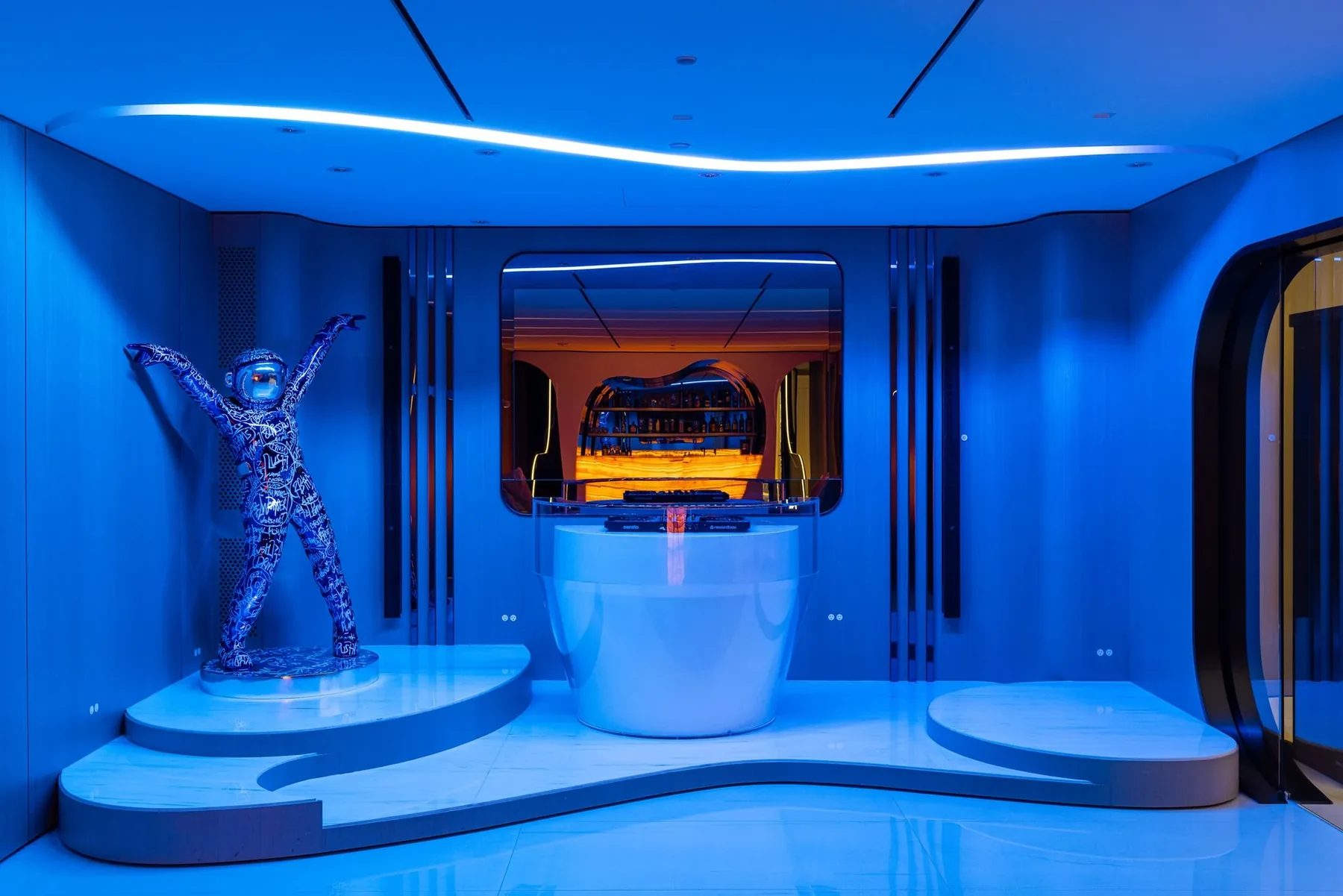
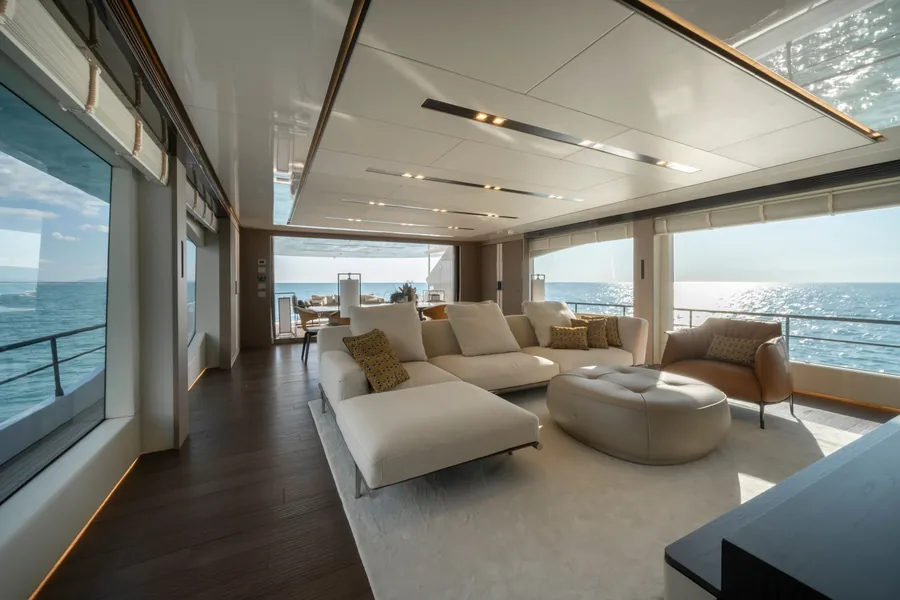
Standard finishes are black and white. Every product can be ordered in any shade from the RAL chart — box and grille. Steel is offered brushed or polished. There is a premium tier in gold and other precious finishes, which sounds absurd until you are standing in a hotel lobby in Beverly Hills.
Several products add marine treatment on request — Vyper and Keystone among them. Coastal California, yacht refits, and any pool house within smelling distance of salt.
The sales move: you are not selling a color option, you are removing the designer's last objection. Bring the RAL fan deck to the meeting. Watch what happens.
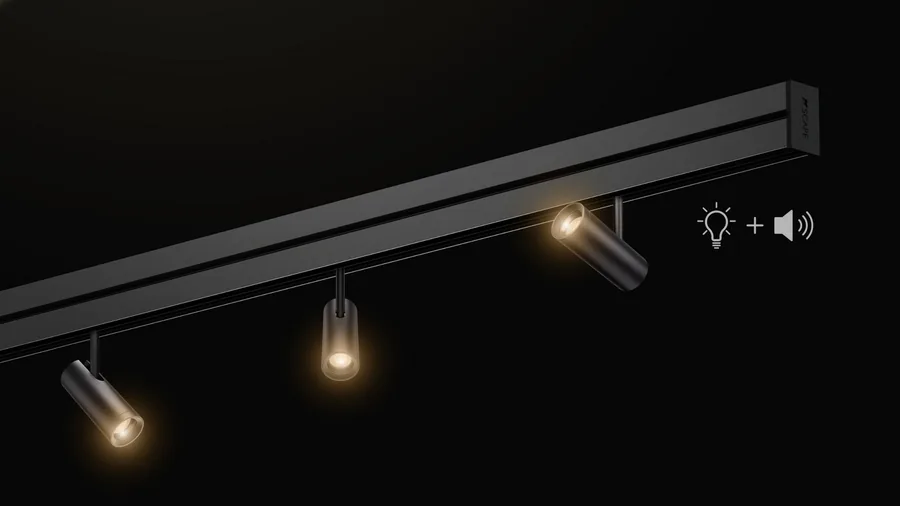
This is the whole line in one habit. A Vyper is 22 mm deep. A Lyzard is 11 mm and weighs 21 grams. Keystone puts real low end in an architectural chassis using Powersoft's MM-Force motor, which cancels its own reaction force so it doesn't shake the wall it is mounted in.
When you walk a site, measure the cavity and the sightline first. K-array wins where depth is the binding constraint — a mullion, a stone wall, a soffit that is already drawn, a historic ceiling nobody is allowed to cut. If you have 8 inches of framing and no design pressure, this is not the line and I will tell you that.
The corollary: stop leading with SPL. Lead with 'what depth do you have,' and let the answer pick the product.
Lyzard. Kobra. Python. Kayman. Anakonda. Dragon. Tornado. Thunder. Rumble. And then — for no reason anyone has ever explained to me — Truffle, which is a fungus, sitting quietly in the middle of the reptile house.
I have made peace with it. A truffle is small, expensive, buried, extremely Italian, and worth considerably more than it looks. Honestly it is the most accurate product name in the catalog.
Domino and Keystone are also not reptiles. Mugello and Firenze are a racetrack and a city, both within driving distance of the factory in Scarperia. Nobody is pretending this was a naming committee.